Frequently Asked Questions
RI PCA assessments are due quarterly. Each quarterly assessment corresponds to the covered lives reported for the applicable measurement period, with payments due as follows:
Reporting Period Payment Due
(Measurement Months) Date
January - March April 30
April - June July 31
July - September October 30
October - December January 30
Payment instructions and the specific due date for each quarter are included on the quarterly remittance form.
State of Rhode Island – Primary Care Assessment Account
PO Box 9718
Providence, RI 02940-9718
Important: Please do not combine RI PCA payments with payments for RIVAP or CHARI. RI PCA, RIVAP, and CHARI are separate programs, and each has its own remittance process, bank account, and mailing address.
RI PCA uses the FEIN for the State of Rhode Island, 05-6000522. A copy of the State of Rhode Island W-9 is available on the RI PCA website under Support → Documents.
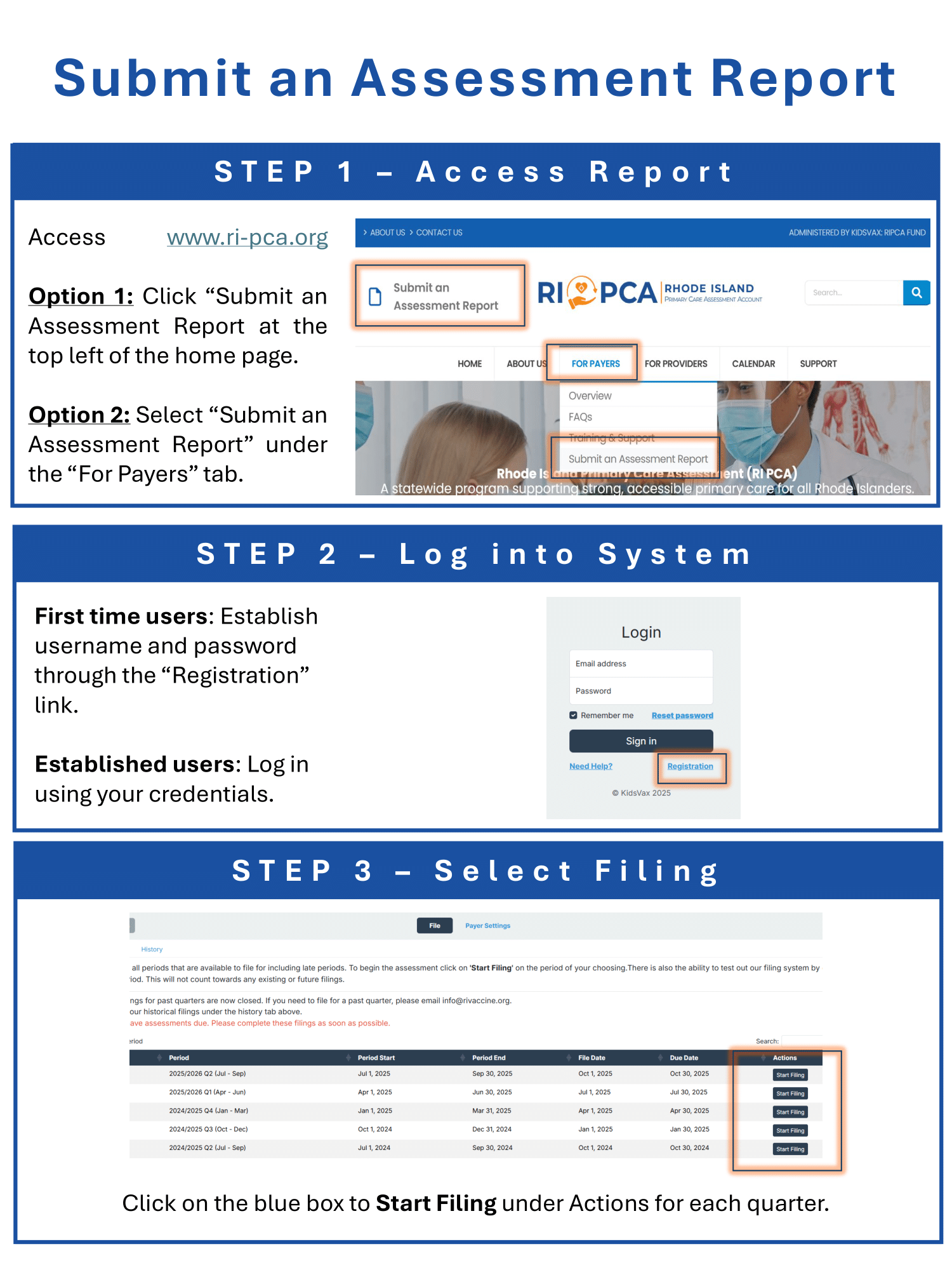
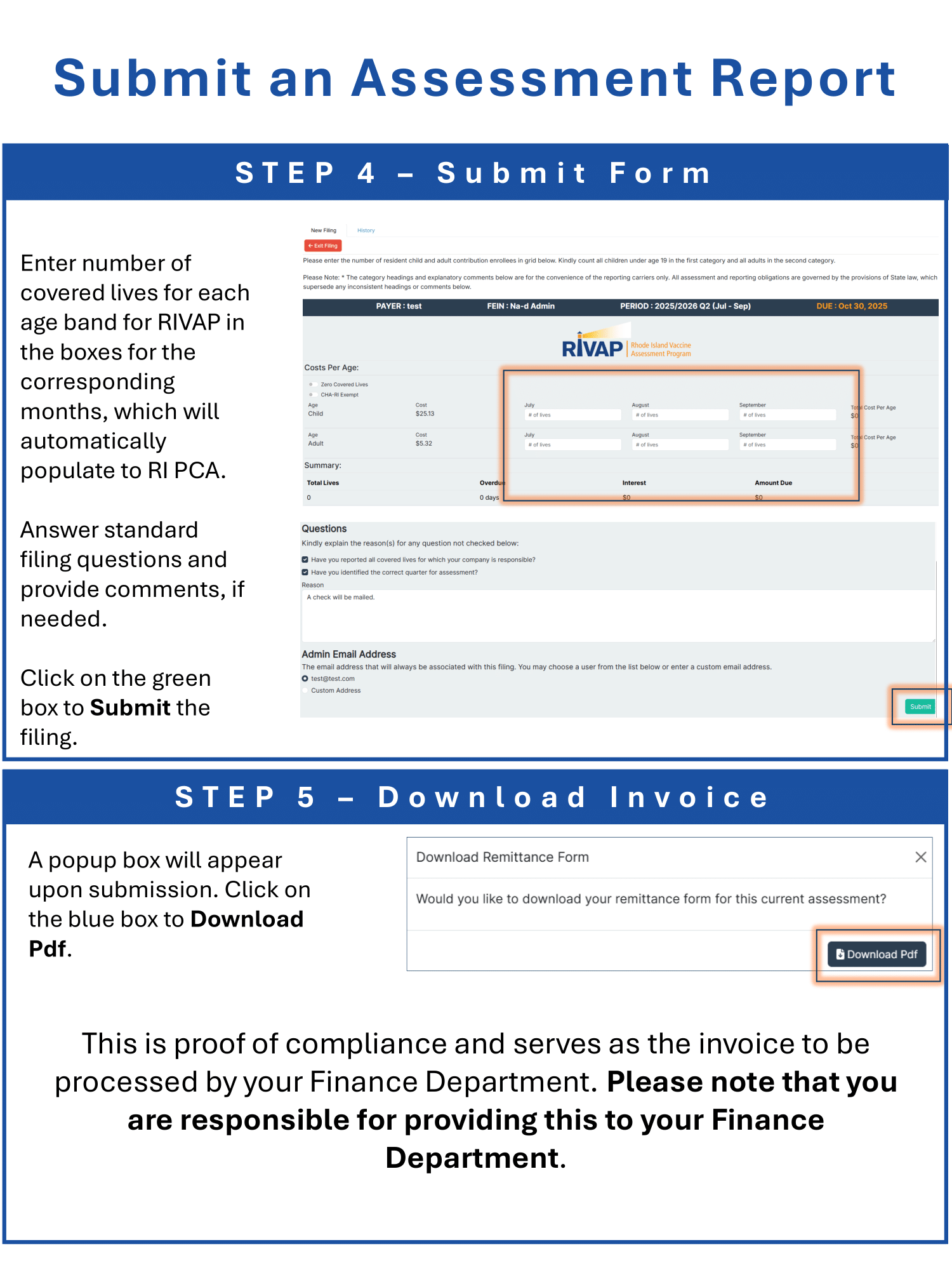
When you file your report in the assessment system on the website, the program will generate a “Remittance Form” that you can print and save. This form will contain a unique reference number. You must include this reference number with your payment. The Form will also include detailed instructions for submitting your payment by ACH transfer, which is the preferred method.
Yes. ERISA does not prevent the state from assessing payers. To the extent allowed by federal law, ERISA plans are required to participate along with all other payers. Third-party administrators (TPAs), who are often contracted to perform claims processing activities for ERISA plan trustees, will also be included in the mandatory assessment.
“Assessable entity” means any health carrier or other entity that contracts or offers to provide, deliver, arrange, pay for, or reimburse any of the costs of health services.
Yes. Each state program is built to meet the needs of its stakeholders. There are various assessment methodologies, adult and children programs, and services that KidsVax® offers. KidsVax® customizes its services to fit each state’s specific needs.
Yes. However, the entity may be eligible to file an Annual or Permanent Zero Covered Lives Report instead of the typical quarterly reports. Please note that if an entity has zero covered lives for one quarter only, then it should file a normal quarterly report with “0” values. If, however, an entity does not administer medical benefits and therefore has zero covered lives, it should file one of two types of Zero Covered Lives Reports. For example, this type of report would be appropriate for entities such as those administering eye care or dental benefit only plans. If the entity has zero covered lives and will continue to have zero covered lives for the balance of the year, then it should file an Annual Zero Covered Lives Report during the first quarter of the calendar year. No other report will be due until the first quarter of the following calendar year. If the entity has zero covered lives and expects to never have covered lives, it should file a Permanent Zero Covered Lives Report to eliminate the need for further compliance follow up. A guide to Zero Covered Lives Reports is available here.
“Adult contribution enrollees” are Rhode Island residents who are 19 years and older. “Child contribution enrollees” are Rhode Island residents who are under 19 years of age.
According to RI Statute 42-7.4-2.3, a contribution enrollee is
(a) “an individual residing in this state, with respect to whom an insurer administers, provides, pays for, insures, or covers health care services, unless excepted by this section.”
A contribution enrollee is not
“an individual whose healthcare services are paid or reimbursed by Part A or Part B of the Medicare program, a Medicare supplemental policy as defined in section 1882(g)(1) of the Social Security Act, 42 U.S.C. 1395ss(g) (1), or Medicare managed care policy, the federal employees' health benefit program, Tricare, CHAMPUS, the Veterans' healthcare program, the Indian health service program, or any local governmental corporation, district, or agency providing health benefits coverage on a self-insured basis”
If annually, you have no lives to report, you may file a permanent zero. At that point, you will not be required to file annually unless you begin to have covered lives to report.
RI PCA assessments are due quarterly. Each quarterly assessment corresponds to the covered lives reported for the applicable measurement period, with payments due as follows:
Reporting Period Payment Due
(Measurement Months) Date
January - March April 30
April - June July 31
July - September October 30
October - December January 30
Payment instructions and the specific due date for each quarter are included on the quarterly remittance form.
State of Rhode Island – Primary Care Assessment Account
PO Box 9718
Providence, RI 02940-9718
Important: Please do not combine RI PCA payments with payments for RIVAP or CHARI. RI PCA, RIVAP, and CHARI are separate programs, and each has its own remittance process, bank account, and mailing address.
RI PCA uses the FEIN for the State of Rhode Island, 05-6000522. A copy of the State of Rhode Island W-9 is available on the RI PCA website under Support → Documents.
When you file your report in the assessment system on the website, the program will generate a “Remittance Form” that you can print and save. This form will contain a unique reference number. You must include this reference number with your payment. The Form will also include detailed instructions for submitting your payment by ACH transfer, which is the preferred method.
Yes. ERISA does not prevent the state from assessing payers. To the extent allowed by federal law, ERISA plans are required to participate along with all other payers. Third-party administrators (TPAs), who are often contracted to perform claims processing activities for ERISA plan trustees, will also be included in the mandatory assessment.
“Assessable entity” means any health carrier or other entity that contracts or offers to provide, deliver, arrange, pay for, or reimburse any of the costs of health services.
Yes. Each state program is built to meet the needs of its stakeholders. There are various assessment methodologies, adult and children programs, and services that KidsVax® offers. KidsVax® customizes its services to fit each state’s specific needs.
Yes. However, the entity may be eligible to file an Annual or Permanent Zero Covered Lives Report instead of the typical quarterly reports. Please note that if an entity has zero covered lives for one quarter only, then it should file a normal quarterly report with “0” values. If, however, an entity does not administer medical benefits and therefore has zero covered lives, it should file one of two types of Zero Covered Lives Reports. For example, this type of report would be appropriate for entities such as those administering eye care or dental benefit only plans. If the entity has zero covered lives and will continue to have zero covered lives for the balance of the year, then it should file an Annual Zero Covered Lives Report during the first quarter of the calendar year. No other report will be due until the first quarter of the following calendar year. If the entity has zero covered lives and expects to never have covered lives, it should file a Permanent Zero Covered Lives Report to eliminate the need for further compliance follow up. A guide to Zero Covered Lives Reports is available here.
“Adult contribution enrollees” are Rhode Island residents who are 19 years and older. “Child contribution enrollees” are Rhode Island residents who are under 19 years of age.
According to RI Statute 42-7.4-2.3, a contribution enrollee is
(a) “an individual residing in this state, with respect to whom an insurer administers, provides, pays for, insures, or covers health care services, unless excepted by this section.”
A contribution enrollee is not
“an individual whose healthcare services are paid or reimbursed by Part A or Part B of the Medicare program, a Medicare supplemental policy as defined in section 1882(g)(1) of the Social Security Act, 42 U.S.C. 1395ss(g) (1), or Medicare managed care policy, the federal employees' health benefit program, Tricare, CHAMPUS, the Veterans' healthcare program, the Indian health service program, or any local governmental corporation, district, or agency providing health benefits coverage on a self-insured basis”
If annually, you have no lives to report, you may file a permanent zero. At that point, you will not be required to file annually unless you begin to have covered lives to report.